 Phone: +91-9654875195
 Email: sales@lcsindia.com


 HOME
HOME ABOUT US
 PRODUCTS
 QUALITY
 QUOTATION
 CLIENTS
 CONTACT US
 Products Range
 Rehabilitation & Exercise Equipment
Exercise and rehabilitation equipment for physiotherapy departments, rehabilitation centres and hospital gyms - from single exercise aids through to parallel bars, training staircases and suspension frames that a room is built around.
Rehabilitation equipment earns its place by being adjustable. A caseload spans a frail patient who cannot yet lift half a kilo and someone training to climb stairs unaided, and equipment that only fits the middle of that range sits unused. Nearly everything below adjusts for height, resistance or angle so one item serves the whole department rather than one patient.
If you are equipping a gym or a new department rather than replacing a single item, send us the room dimensions and the caseload you expect and we will put together a layout and a combined quotation.
Gait Training and Mobility
The large items a rehabilitation gym is planned around - walking bars, training stairs and the mirror that gives the patient feedback on what they are doing.


Shoulder and Upper Limb
Wall-mounted and pulley equipment for shoulder, arm and elbow range and strength. Most mount on the wall, which keeps the floor clear.


Hand, Wrist and Finger
Fine motor, grip and small joint work - peg boards, spring boards and pulley tables for the hand.


Lower Limb, Knee and Ankle
Quadriceps chairs and seated ankle and heel units, for loading the leg before the patient is ready to take weight through it.


Exercise Cycles and Cardio
Static cycles, pedal exercisers and rowing units. The pedal exercisers reach patients who cannot mount a full-size bike.
.jpg)


Multi-Exercise Units and Chairs
Combined frames that cover several exercises in one footprint, for departments where floor space is the limit.


Suspension, Traction and Treatment Tables
Suspension frames, traction tables and treatment couches - the furniture a treatment room is built on.


Weights and Exercise Aids
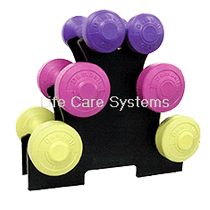
Graded weights, balls, bolsters and resistance bands. The sets are graded so the progression is already in the room.




Goniometers and Measurement
Range of motion measurement. Progress is only progress if it is recorded the same way each time.


Infrared and Ultraviolet Lamps
Radiant heat and ultraviolet therapy lamps, in table and floor-standing models.


Frequently Asked Questions
What equipment does a physiotherapy rehabilitation gym need?
The large items a room is planned around are parallel bars for gait re-education, a training staircase, a postural mirror and a treatment couch. Beyond those, most departments add shoulder and upper limb equipment, a quadriceps chair, an exercise cycle, graded weights and goniometers for measurement. Tell us your room dimensions and caseload and we will propose a layout.
Why do training staircases have two different step heights?
Because patients progress. Our LCS-491 has 7.5 cm steps on one side for early practice and 15 cm steps - domestic stair height - on the other. The first step also moves into the second to form a 30 cm bus step, so the height a patient will meet getting onto public transport can be practised before discharge.
What is a suspension frame used for?
Sling suspension supports the weight of a limb so a muscle too weak to lift it against gravity can still move it through range. Mesh across the top of the frame lets a sling be hung at any point relative to the patient rather than at fixed positions.
What is the difference between a manual and a motorised tilt table?
Both bring a patient from lying towards standing in graded stages. A manual table is adjusted by the therapist; a motorised table changes angle under power, which matters with heavier patients and for slow, fine adjustments, and frees the therapist to watch the patient rather than operate the mechanism.
Why do goniometer readings need to be consistent?
Range of motion is the number a rehabilitation programme is judged on. It only means anything if it is measured the same way each time, so the instrument should be sized to the joint - a full-size goniometer cannot sit accurately on a finger - and readings taken from the same landmarks by whoever is assessing.